Why Mastering Statistics is the Secret to Writing Better Business Reports
In the modern corporate landscape, the ability to write a compelling report is no longer just about having a way with words. While a well-structured argument is vital, today’s business leaders demand more than just narrative—they demand proof. This shift has placed a premium on “data storytelling,” where the writer’s ability to interpret numbers becomes the backbone of their professional credibility. For undergraduate students, understanding this connection early on is the difference between producing a standard classroom paper and a high-impact professional document.
When you transition from general academic writing to professional contexts, the expectations for precision increase. Navigating the specific formatting and ethical guidelines of diverse educational systems requires a nuanced approach. Many students finding themselves overwhelmed by these shifting requirements often look for assignment help Australia to understand how to align their technical findings with specific local rubric standards. This regional expertise ensures that a report doesn’t just sound good, but also adheres to the rigorous professional expectations of the target market.
The Evolution of the Business Report
A decade ago, a business report might have relied heavily on qualitative observations—interviews, general market trends, and anecdotal evidence. Today, the “Big Data” revolution has changed the stakes. A report that suggests a “significant increase in customer interest” without a p-value or a confidence interval to back it up is often dismissed as subjective.
Mastering statistics allows a writer to move from “I think” to “the data demonstrates.” This transition is crucial because:
- It Minimizes Bias: Numbers provide an objective floor for your arguments.
- It Projects Authority: Using statistical terminology correctly shows that you have done the heavy lifting.
- It Predicts Future Trends: While qualitative data looks at the now, statistics allow for predictive modeling.
Core Statistical Concepts Every Student Needs
You don’t need to be a mathematician to write a brilliant business report, but you do need to understand the “Big Three” of data interpretation.
| Statistical Concept | Application in Business Reporting | Impact on the Reader |
| Mean, Median, Mode | Identifying average sales vs. the most frequent customer spend. | Provides a “snapshot” of typical behavior. |
| Standard Deviation | Showing how much risk or variance exists in a project timeline. | Indicates reliability and consistency. |
| Correlation vs. Causation | Proving that Marketing Spend actually caused the Sales Spike. | Prevents logical fallacies and false conclusions. |
Bridging the Gap Between Data and Narrative
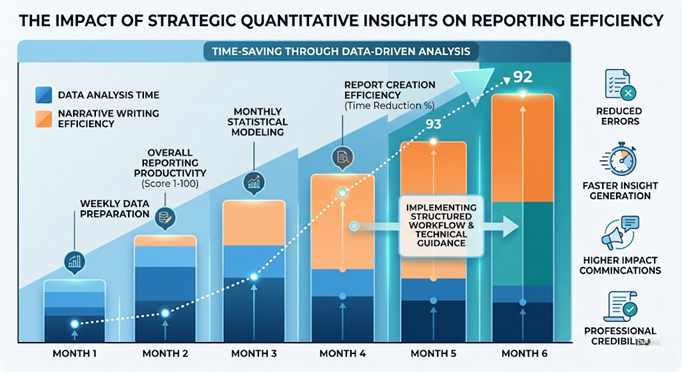
The biggest challenge for most undergraduates is the “translation” phase. It is one thing to run a T-test in a software package; it is quite another to explain why that T-test matters to a Chief Financial Officer. A common mistake is “data dumping,” where the writer includes every chart they generated without explaining the “why.”
Effective reports use statistics as the “evidence” in the PEEL (Point, Evidence, Explanation, Link) paragraph structure. For instance, if your point is that a new software tool increases productivity, your evidence should be the statistical percentage of time saved across the trial group.
Navigating the Complexity of Quantitative Analysis
For many, the jump from basic arithmetic to inferential statistics is the most daunting part of their degree. It isn’t just about the math; it’s about knowing which test to run and how to interpret the output without making errors that could lead to poor business decisions. During these high-pressure periods, leveraging statistics homework help through MyAssignment Services can be a strategic way to master these complex concepts. Instead of struggling in a vacuum, seeing how a professional analyst breaks down a dataset can provide the clarity needed to finish a report with confidence. This kind of targeted support helps bridge the gap between “knowing” the math and “applying” it to a real-world scenario.
Visualizing the Data: Why Charts Aren’t Enough
A great business report uses visuals to simplify, not complicate. If a paragraph is getting too bogged down in numbers, it’s time for a table or a chart. However, every visual must have a “caption of significance.” Never assume the reader sees what you see. If you include a bar chart showing declining costs, your text should explicitly state: “As shown in Figure 1, the 12% reduction in overhead suggests our lean strategy is effective.”
Formatting for the Professional Eye
Undergraduate students often write for a professor who is paid to read their work. In the business world, people read “skimmingly.” This means your statistics should be easily findable.
- Use Bold Key Findings: Highlight the most important percentages.
- Bullet Points for Data Lists: Don’t bury numbers in long paragraphs.
- Executive Summaries: Always lead with the most significant statistical takeaway.
The Ethics of Data Reporting
With great power comes great responsibility. One of the secrets to ranking high in credibility—and on search engines—is honesty. “Cherry-picking” data to make a project look better than it is might work in the short term, but it ruins professional reputations. A high-quality report acknowledges the limitations of the data. If your sample size was small, say so. This transparency actually builds more trust with a manager or a client than a “perfect” but questionable result.
Conclusion: The Future belongs to the Data-Literate
As AI and automated tools become more common, the role of the human writer is shifting toward interpretation. Anyone can generate a chart, but only a skilled writer can explain the human story behind the numbers. By mastering the intersection of statistics and report writing, you aren’t just finishing an assignment; you are building a toolkit that will make you indispensable in any industry.
Frequently Asked Questions (FAQ)
Q.1. Do I need to be an expert in math to write a good business report?
Ans: Not necessarily. You need to be an expert in interpretation. Most business reports rely on descriptive statistics (averages, trends, percentages) rather than high-level calculus. Understanding what the numbers mean for the business is more important than the manual calculation.
Q.2. What is the most common mistake students make with statistics?
Ans: The most common error is confusing correlation with causation—assuming that because two things happened at the same time, one caused the other. Always look for the “third variable” that might be influencing your results.
Q.3. How long should a professional business report be?
Ans: While academic assignments have strict word counts, professional reports should be “as long as necessary, but as short as possible.” Focus on high-impact data and clear headings to keep the reader engaged.
Q.4. Why is data visualization so important?
Ans: The human brain processes images 60,000 times faster than text. Using a well-designed chart to represent complex statistics ensures that your main point isn’t lost in a wall of text.
Q.5. How can I improve my statistical literacy quickly?
Ans: Start by reading the “Business” or “Economy” sections of reputable news outlets. Pay attention to how they explain data trends to a general audience. Practice is key—the more you analyze real-world datasets, the more natural the writing becomes.
About The Author
I am Min Seow, a senior academic consultant and content strategist at MyAssignment Services. With extensive experience in developing high-authority educational content, I specialize in bridging the gap between complex academic skills and global professional standards.